Why Gout Hits the Big Toe First
Gout hits the big toe first in roughly half of all first attacks, and it is not coincidence or bad luck. The joint at the base of the big toe is the coldest heavily-used joint in the body, it absorbs more mechanical load per square centimetre than any other joint you own, and it has spent decades accumulating the kind of cartilage damage that urate crystals like to build on. Put those together and the big toe is exactly where the chemistry says gout should start.
Podagra: an old word for a specific thing
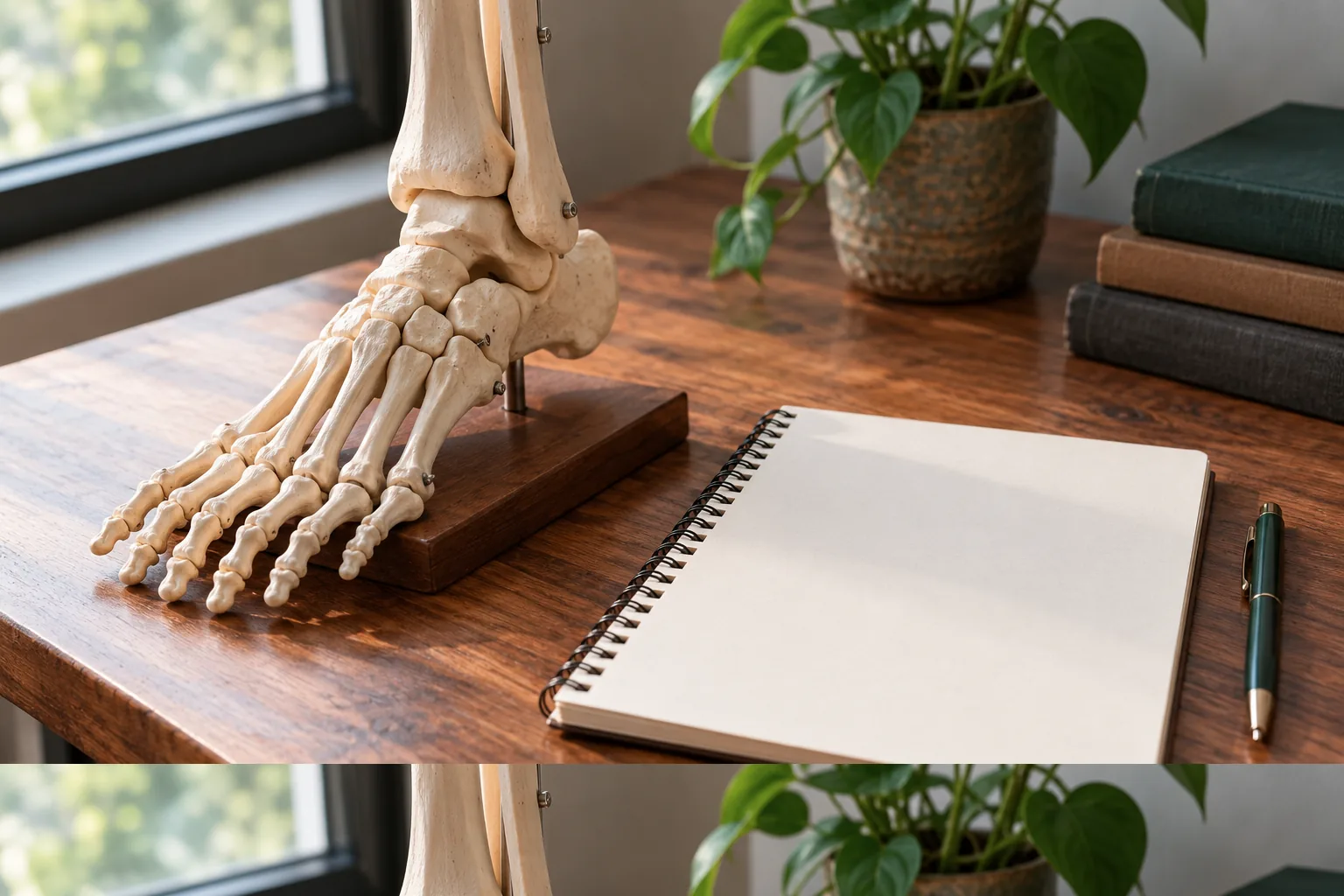
Gout in the first metatarsophalangeal joint — the hinge where the big toe meets the foot — has its own name, podagra, from the Greek for “foot trap”. It has been described in medical texts for well over two thousand years, which tells you how consistent and how recognisable the pattern is.
Podagra is not a different disease. It is ordinary gout in the joint that gout reaches first. Around half of people have their first attack there, and the large majority of people with gout will have an attack there at some point.
Reason one: it is cold out there
Urate stays dissolved up to about 6.8 mg/dL (roughly 405 µmol/L) at core body temperature. Drop the temperature and that ceiling drops with it — the same blood that is comfortably under-saturated at 37°C can be over-saturated a few degrees cooler.
Your extremities run cooler than your core all the time. Toes at the far end of the circulation, inside a shoe or sticking out from under a duvet, can sit several degrees below 37°C, and the first MTP joint sits right at the end of that gradient with very little muscle around it to generate heat. It is a small, poorly insulated, poorly perfused joint at the outer edge of the body.
That temperature effect is why gout favours toes, then midfoot and ankle, then knees and fingers, and why it almost never bothers the hip or shoulder. Deep, well-insulated, muscle-wrapped joints simply do not get cold enough. It is the same physics described in our overview of what gout actually is.
Reason two: no joint works harder
Walking pushes a force of several times your body weight through the forefoot at push-off, and the great toe joint takes the bulk of it. Over an average lifetime that joint flexes somewhere in the order of a hundred million times.
All of that produces micro-trauma: small areas of roughened, damaged, imperfect cartilage. Damaged cartilage matters here because crystals do not form easily in perfectly smooth solution — they need a nucleation site, a surface for the first crystal to build on. Rough cartilage, small cartilage fragments and the debris of repeated low-grade injury are ideal seeding surfaces.
This is also why people with a bunion, with a stiff arthritic great toe, or with an old toe injury seem disproportionately likely to have gout land there. The damage came first and the crystals found it.
Reason three: the overnight convergence
Attacks cluster in the small hours because several things that favour crystallisation happen at the same time:
- Body temperature falls during sleep, and peripheral joints cool furthest — especially a foot poking out from under the covers.
- You get mildly dehydrated across seven or eight hours without fluid, which nudges blood urate concentration up.
- Cortisol bottoms out in the early hours. Your own natural anti-inflammatory steroid is at its lowest point exactly when the crystals are most likely to be shed.
- Joint fluid redistributes. Water is reabsorbed from the joint space when the joint is at rest and unloaded, which can concentrate what is left behind.
None of these alone would do it. Together they make three in the morning the most likely hour of your year for a first flare, which is why so many people describe the onset in our piece on what a first attack feels like.
Worth holding on to: the big toe is not where gout is — it is where gout shows first. Crystals have usually been depositing silently in several joints for years before one of them gets loud enough to wake you up. The toe is a smoke alarm, not the fire.
If your first attack was somewhere else
Around half of first attacks are not in the great toe. The commonest alternatives are the midfoot and instep, the ankle, the heel, the knee, and less often the fingers, wrist or the bursa at the tip of the elbow. All of those follow the same cool-and-worked logic, just further up the list.
What it means practically:
- Ankle or midfoot first is common and unremarkable. It behaves like podagra and is treated identically.
- Knee first raises the value of getting fluid out of the joint, because a hot knee has a wider differential — pseudogout, reactive arthritis and infection all like knees.
- Fingers or wrists first, particularly in older women taking a diuretic, is a well-recognised pattern that is frequently misread as osteoarthritis or rheumatoid arthritis.
- Several joints at once on a first attack is unusual and should prompt a careful look for something else.
In all of these cases the diagnosis rests on the same evidence it always does, which is why how gout is diagnosed is worth understanding before you sit down in the consulting room.
One safety point that applies to any hot joint
A single hot, swollen, exquisitely painful joint is also how a joint infection presents. If there is fever, shaking chills, or you feel systemically unwell, that is septic arthritis until proven otherwise — it damages the joint within days and needs urgent medical assessment rather than home treatment. Having a history of gout does not protect you; if anything, a previously damaged joint is easier to infect.
Does footwear make the toe more vulnerable?
Indirectly. Shoes with a narrow toe box crowd the great toe joint and add to the mechanical stress it already carries, and a cold, damp shoe keeps the joint cooler. Neither causes gout — the urate level does that — but both make life harder for a joint that is already the weak link, and comfort during and after a flare is a genuine issue worth solving, which is why we looked at what actually helps in a shoe.
Frequently Asked Questions
Is pain at the base of the big toe always gout?
No. Hallux rigidus (arthritis of that joint), a bunion, sesamoiditis, a stress fracture and turf toe all cause pain in the same place. What distinguishes gout is the timeline — nothing to unbearable overnight — plus heat, glossy skin and extreme tenderness to light touch.
Why does gout keep coming back to the same toe?
Because the crystal deposit is already there. Once a joint has been seeded, that deposit persists and can shed again, so recurrences tend to favour previously affected joints until sustained urate lowering dissolves the deposit away.
Can gout affect both big toes at once?
It can, but it is uncommon and more typical of long-standing disease than of a first episode. Symmetrical involvement of both feet at once should make a clinician think harder about other kinds of arthritis.
Does keeping the foot warm prevent attacks?
There is a logic to it, and warm socks cost nothing, but no one has shown that warmth prevents flares in practice. It is a reasonable comfort measure, not a treatment strategy — and during an attack most people find cool packs more bearable on the joint itself.
What to read next
- What to do in the first hours of an attack
- Gout symptoms and how a first attack unfolds
- The four stages of gout, and why the quiet one matters most
- What happens if gout goes untreated